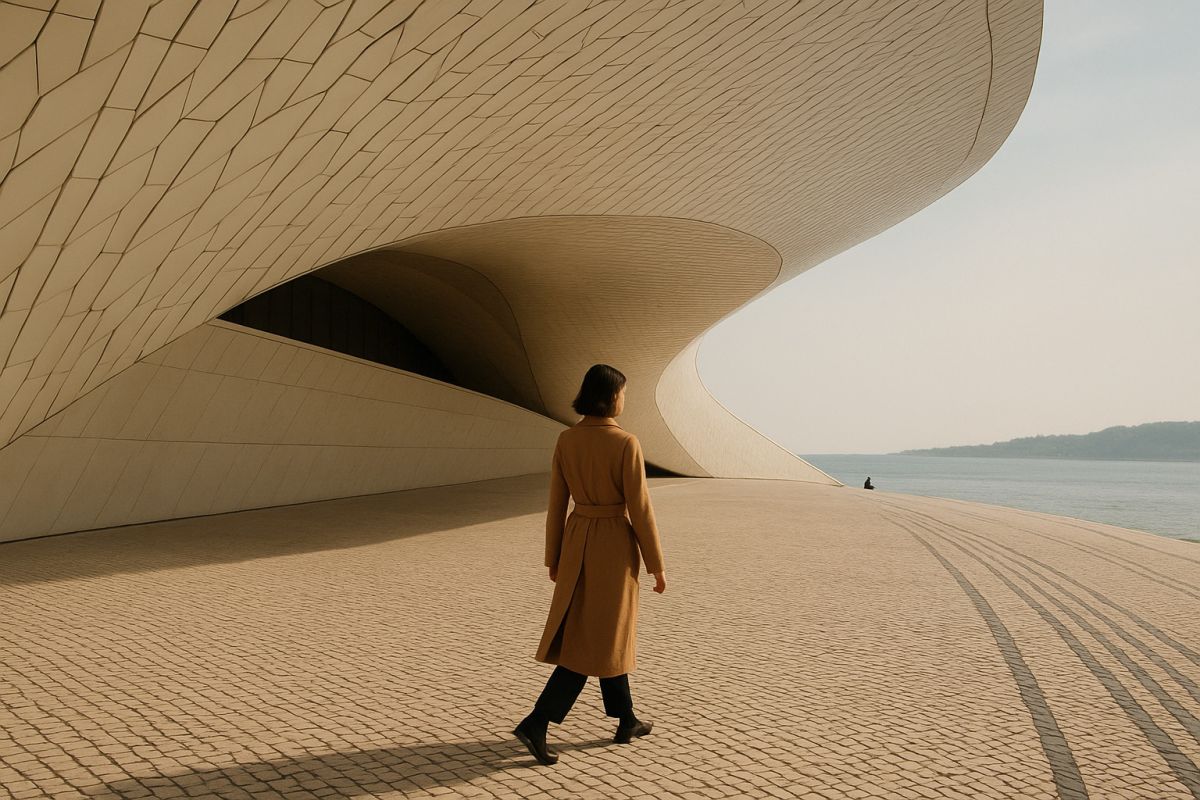
The undulating ceramic facade of the MAAT museum offers the cleanest, most sculptural backdrop for contemporary portraits anywhere along the Lisbon waterfront. While the historic districts rely on warm pastel plaster, cobblestones, and decorative ironwork, this stretch of Belém provides a stark, modern counterweight dominated by white tile, pale concrete, and wide-open sky. For anyone who wants pictures that prioritize negative space, sharp lines, and an editorial feel, the building functions less like a monument and more like a massive, naturally lit outdoor studio.
The Glazed Ceramic Façade Acts as a Giant Softbox
The exterior of the museum is clad in three-dimensional, cracked-glaze ceramic tiles designed to interact directly with the intense Portuguese sunlight. Lisbon can present harsh lighting, especially in the middle of the day when shadows turn sharp and unforgiving. The textured tiles solve this problem by scattering light in multiple directions, effectively acting as an immense reflector that bounces soft, even illumination back into a subject's face.
When I position someone along the sweeping lower curve near the water, we avoid the dark eye sockets and sharp facial shadows that typically happen under direct overhead light. The pale surfaces lift the shadows naturally, eliminating the need for bulky artificial lighting gear or flash brackets that draw unwanted attention. This allows us to keep the session light, quiet, and fast-moving, which is particularly beneficial if you have never worked with a professional photographer before and feel slightly self-conscious in public spaces.
Expansive Geometry Removes Visual Distractions Completely
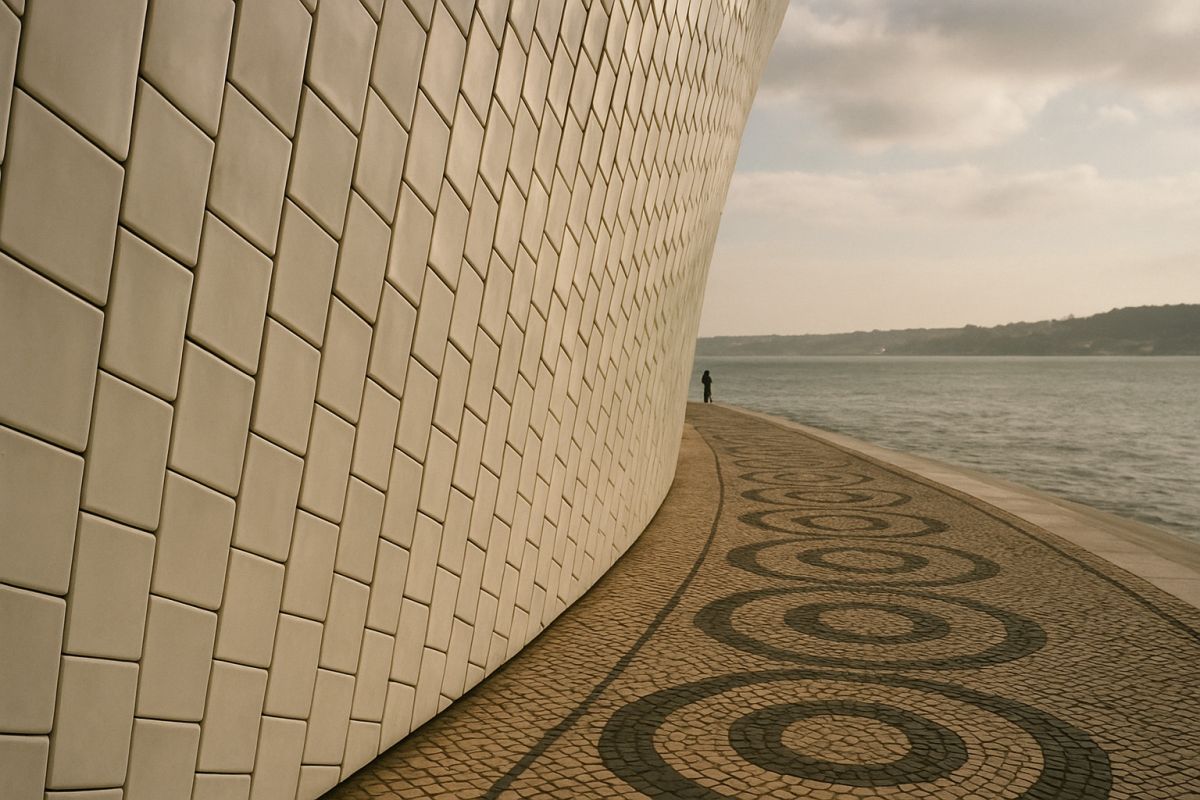
Traditional street portraits in central neighborhoods are a constant negotiation with urban clutter, including power cables, parked scooters, road signs, and dense pedestrian traffic. The pedestrian precinct surrounding MAAT completely eliminates that friction. Here, the visual language is stripped down to sweeping horizontal curves, vast planes of poured concrete, and the unbroken line where the Tagus River meets the horizon.
This level of visual purity fundamentally changes how a portrait works. Instead of competing with a busy environment, your silhouette, posture, and facial expression take center stage. When working on contemporary sessions for women who want modern personal branding or editorial imagery, these minimalist photo spots provide breathing room in the frame. The background supports the subject without ever demanding attention for itself.
Timing the Tagus River Light for Crisp Architecture
The museum sits low on the riverbank, fully exposed to the southern sky, which means the quality of light transforms dramatically across just a couple of hours. Morning sessions here offer crisp, pale tones with clear separations between the white structure and the deep blue water. The pedestrian walkway is quiet, the air is usually still, and the clean white surfaces look exceptionally bright and modern.
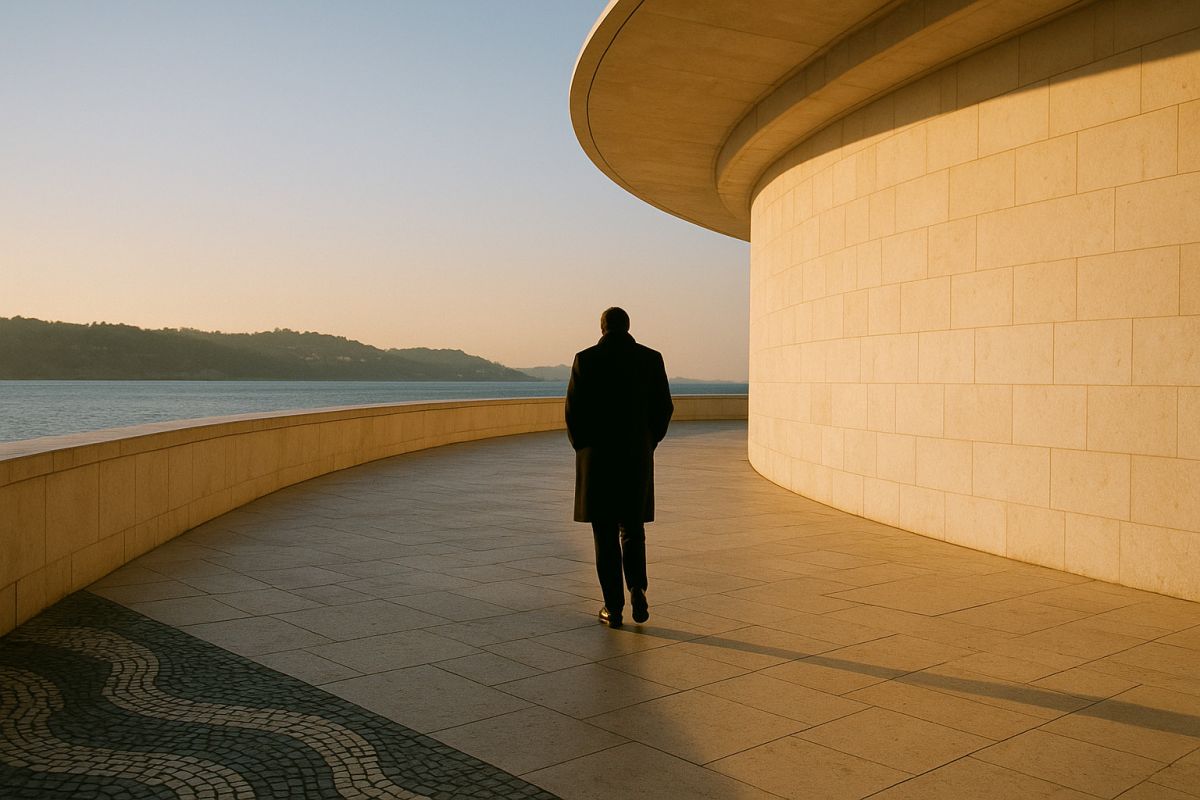
Late afternoon introduces a warmer, raking light that cuts across the textured ceramic panels at a low angle, emphasizing their three-dimensional relief. As the sun sinks lower toward the Atlantic, the concrete roof shifts from stark white to warm limestone tones. I tend to plan our route based entirely on this progression, starting on the shaded northern side of the building where the light is cool and flat, before moving up toward the open rooftop as the shadows lengthen across the river.
Wardrobe Choices That Complement Minimalist Architecture
A stark, futuristic location requires intentional styling, because intricate patterns, delicate florals, and busy prints tend to clash with bold architectural lines. The strongest images at this location come from deliberate contrast or deliberate tonal matching. Structured clothing with clear edges works best: tailored blazers, long trench coats, wide-leg trousers, or dresses with clean, architectural cuts.
For palette selection, monochrome approaches are almost impossible to beat. Black, charcoal, off-white, and deep navy establish strong contrast against the pale ceramic panels. If you prefer color, a single saturated hue, such as a deep emerald green, terracotta, or cobalt blue, cuts through the neutral background without visual chaos. During private sessions for men, simple high-density fabrics like structured wool, heavy cotton, or crisp linen maintain their shape in the river breeze, preventing the clothing from bunching or looking untidy in wide environmental portraits.
Natural Movement Replaces Rigid Posing on Open Ramps
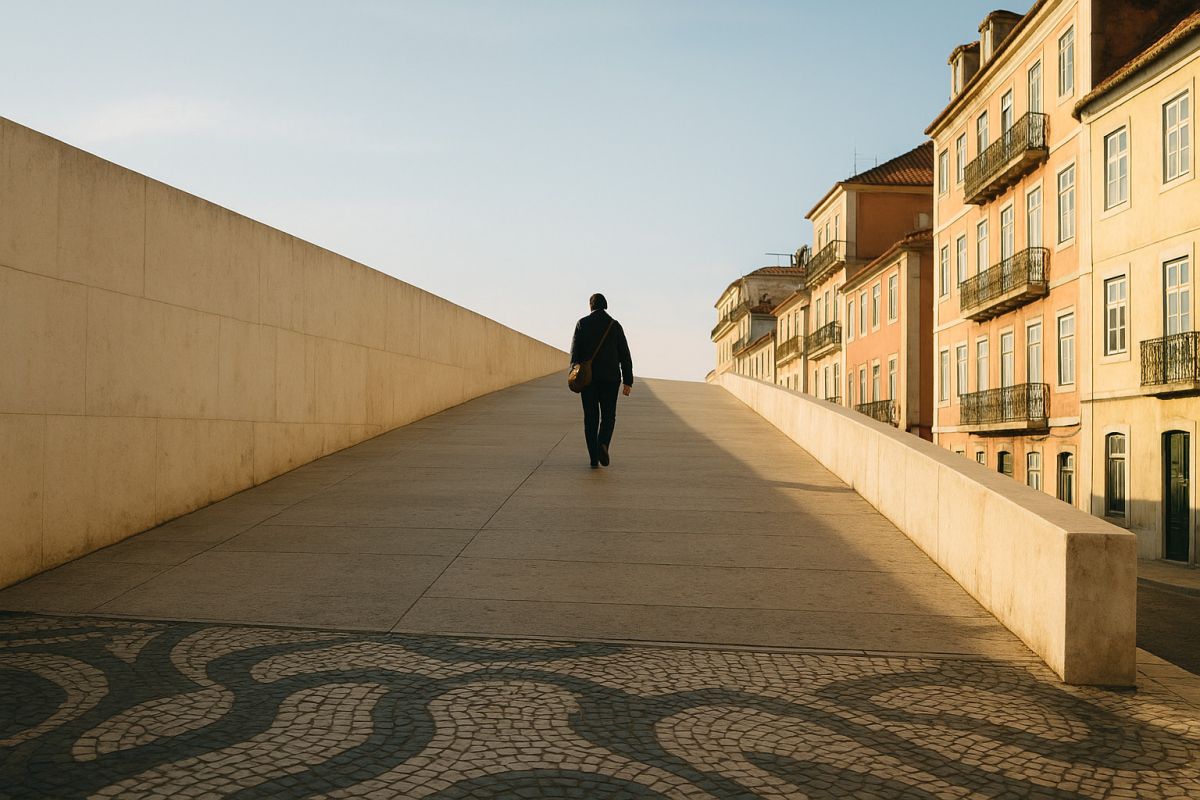
Standing in an open architectural plaza can feel intimidating if you are instructed to freeze into static poses. The scale of the space makes people hyper-aware of their hands, their posture, and their surroundings. To counter that awkwardness, I treat the museum's network of outdoor ramps, broad stairs, and cantilevered walkways as a continuous path rather than a series of fixed stops.
I will often ask you simply to walk along the sweeping rooftop curve, adjust your jacket, or look out across the water while keeping a steady pace. Because the surface is wide and unobstructed, you can move freely without watching your step or dodging cobblestones. Movement immediately releases physical tension in the shoulders and jaw line. It creates fluid drapery in your clothing and allows me to capture genuine frames between steps, rather than staged poses held until they feel unnatural.
Balancing Monumental Scale with Genuine Personal Presence
The primary trap with MAAT museum architecture is falling in love with the building and forgetting the person standing in front of it. It is very easy for a photographer to back up thirty meters to capture a massive sweeping arch, reducing the human subject to an anonymous speck. That approach makes for fine architectural portfolio work, but it fails as a portrait.
Every wide, sweeping frame that establishes the dramatic environment should be paired with medium and close-up compositions where the architecture serves purely as subtle graphic context. A slight tilt of the head against a curved white horizon or hands resting on a clean concrete balustrade keeps the focus entirely human. As a photographer in Lisbon, my priority is ensuring that even in the most futuristic setting, the final images feel like an authentic reflection of who you are, rather than an abstract study in concrete and tile.