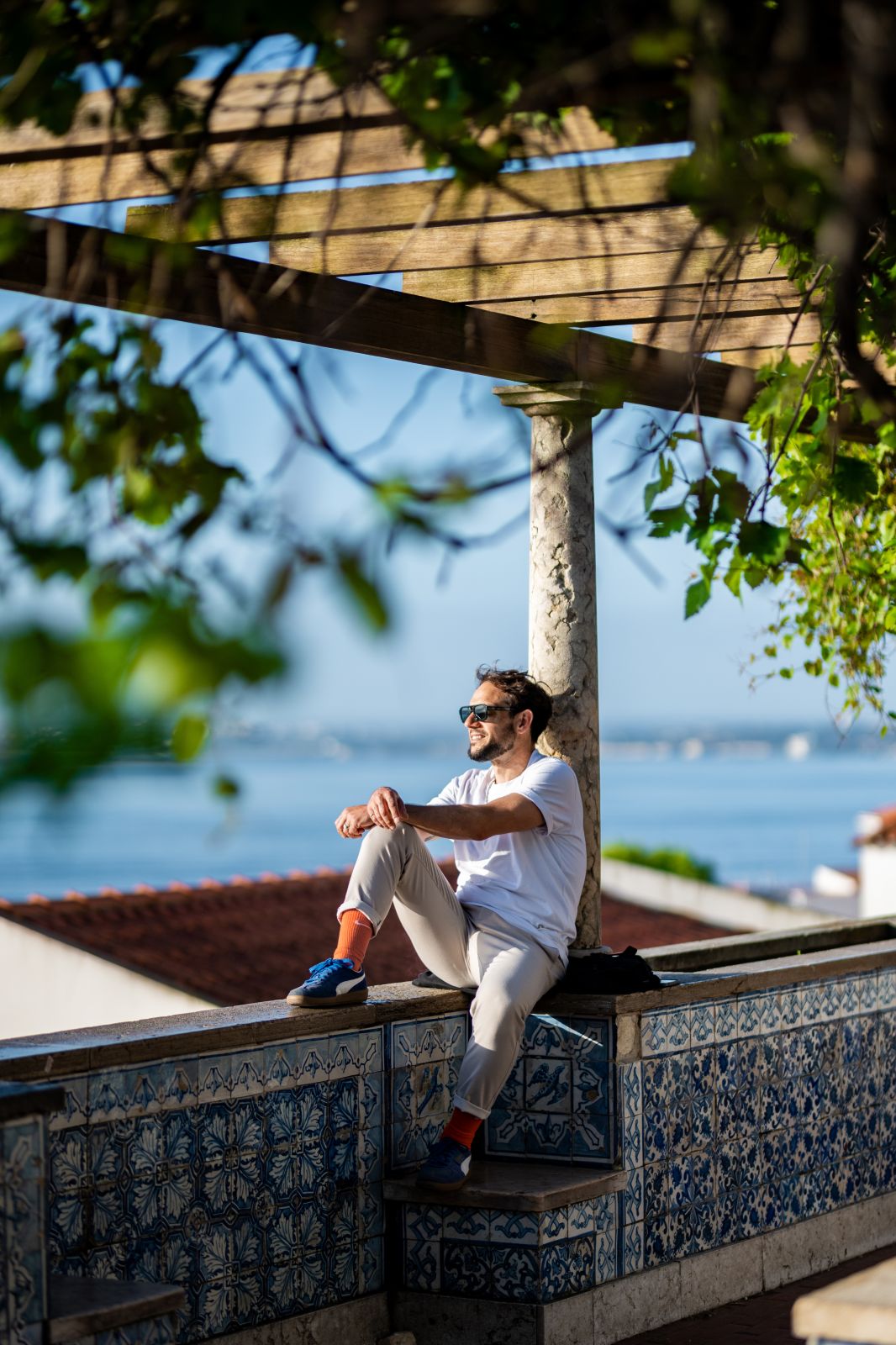
The best wardrobe for a men's photo shoot consists of well-fitted layers, muted neutral tones, and substantial textured fabrics that maintain their structure while moving. When preparing for portrait photo shootings, your clothing needs to support your face rather than dominate the frame. A camera captures volume and fabric tension differently than a bathroom mirror, meaning that excess fabric reads as messy, while overly tight items restrict natural body language. Selecting two distinct, well-tailored outfits – one smart-casual and one slightly more relaxed – gives you a diverse set of images without turning the session into a disruptive wardrobe exercise.
Fit defines the portrait before color even registers
A great outfit fails on camera if the shoulder seams droop or the trousers pool excessively over your shoes. Camera lenses accentuate silhouette lines first, especially in the clear morning light around Chiado where clean edges stand out against stone backgrounds. When a jacket or overshirt sits square on your shoulders, your posture reads as grounded and upright without requiring you to stand unnaturally stiff. Clothing that is cut too loose billows in the Atlantic breeze, creating an unflattering and bulky shape that misrepresents your actual build.
Trousers require identical precision. Tailored chinos or straight-leg dark denim should feature a clean drape with a slight or zero break at the ankle. When hems bunch up across the top of your footwear, they shorten the leg line and make the entire lower half look unkempt. Stretch materials that cling tightly to the calves or thighs should also be left behind, as they crease unpredictably as soon as you sit down on a step or walk along the pavement. Structured cotton, heavier wool, and stiff twill hold their line through every movement, letting you move naturally while preserving a clean profile.

Solid neutrals outperform high-contrast prints on camera
Camera sensors react poorly to high-contrast graphic prints and tiny repeating patterns. Micro-checks, tight gingham, and narrow stripes trigger moiré, which appears as an unwanted digital ripple across the image that cannot always be fixed during editing. Bold graphic t-shirts and prominent designer logos are equally problematic because they immediately pull the viewer's eye away from your expression and anchor the photo to a specific, often dated aesthetic.
Muted, understated tones work best in portrait work. Rich navy, charcoal, slate grey, warm beige, camel, and washed olive sit naturally against urban European architecture. Stark, bright white shirts often reflect too much light on sunny days and wash out facial highlights, so replacing pure white with ivory, stone, or soft cream provides a much softer dynamic range. Darker colors ground the torso, ensuring that the viewer looks directly at your face and eyes instead of your chest.
[IMAGE_PLACEHOLDER: "A man in his early thirties sitting calmly on a stone bench in warm morning light, wearing a tailored olive green overshirt, a cream crewneck knit, and dark navy chinos, shot with a blurred urban street background."]
Layering adds depth and versatility to portrait photo shootings
Layering creates visual dimension and instantly solves the common question of what to do with your hands. A standard t-shirt worn alone can appear flat and formless on camera, offering no shadows or textural variation. Putting an unstructured blazer, a suede jacket, or a heavy wool overshirt on top adds sharp collar lines and shoulder structure, immediately enhancing your upper frame. These open layers create a vertical line down the center of your torso that elongates the body naturally.
Jackets and open shirts also offer practical physical anchors during the shoot. You can rest a hand naturally on an open lapel, push a single hand into a jacket pocket, or adjust a cuff without ever feeling posed or rigid. During a standard shoot, peeling off an outer layer or trading a jacket for an overshirt yields an entirely new look in seconds without searching for a changing room. This efficiency ensures we spend the majority of the hour shooting rather than handling wardrobe logistics.

Smart casual remains the strongest look for dating photography
Dating profiles require an image that balances effort with approachability, making formal black-tie suits and worn gym clothes equally counterproductive. When shooting for dating photography, your clothes must show that you take care of yourself without suggesting that you dressed up exclusively for a camera lens. A dark pair of clean-hemmed denim combined with an unstructured sports jacket or a fine-gauge merino knit strikes the right tone. It communicates social ease, refinement, and maturity.
The outfit should reflect where you would actually take someone on a great Friday evening, perhaps an intimate wine bar in Bairro Alto or a quiet neighborhood bistro. Clean leather minimalist sneakers in immaculate condition or brown suede Chelsea boots finish the look properly. Avoid heavily worn running shoes or scuffed athletic trainers, as footwear is often the first detail people notice when viewing a full-length portrait. The objective is to present an elevated, confident version of your daily reality.
[IMAGE_PLACEHOLDER: "Close-up detail photograph of a man's outfit, highlighting the rich texture of a charcoal herringbone wool jacket, a dark navy crewneck sweater underneath, and a clean stainless steel wristwatch in soft daylight."]Textures elevate urban street scenes across Lisbon
Flat, synthetic cotton blends often look lifeless when hit by direct sunlight, whereas rich, tactile fabrics absorb and reflect light in subtle gradations that add physical quality to the image. Heavier materials like brushed flannel, corduroy, waffle knits, and genuine suede introduce depth that makes a portrait feel tactile and cinematic. They hold their own against historic backdrops, blending seamlessly with the weathered textures of older neighborhoods.
Walking through areas like Alfama or the residential lanes near Príncipe Real, the city presents a blend of limestone walls, aged wood doors, and iron railings. An outfit composed of tactile fabrics matches the character of these surroundings. When the material of your coat or sweater possesses physical weight and texture, you look completely integrated into the setting rather than superimposed over it.
Practical preparation protects the clean lines of your clothing
The items you empty out of your pockets before shooting are just as important as the garments you put on. Bulky smartphones, thick cardholders, and heavy key sets distort the drape of trousers, creating odd silhouettes in side-profile shots. Emptying every pocket entirely before we begin walking is the simplest way to maintain clean bodily proportions. You can pass your small items to me or bring a simple shoulder bag to store your daily carry while we move.
Ironing or steaming every piece the morning of the shoot is essential, as wrinkles cannot be fully removed in post-production without looking artificial. If you bring a secondary top, carry it on a structured hanger instead of folding it tightly into a backpack where it will collect hard creases. During my portrait sessions in Lisbon, we spend the first few minutes checking collar symmetry, cuff placement, and pant breaks. Addressing these practical factors before taking the first frame allows you to relax into the session with absolute confidence that the camera is capturing you at your best.